Aiste – ‘The Calamitous Burning’

Aiste dheifnídeach ón Oll. Liam Irwin, The Calamitous Burning: The Dromcollogher Disaster of 1926

Thubaiste Phictiúrlann Dhrom Collachair > Aiste – ‘The Calamitous Burning’

Scríobh Liam Irwin, an tOllamh Staire ó Choláiste Mhuire gan Smál, Luimneach, atá anois ar scor, ailt faoi thubaiste Dhrom Collachair d’irisleabhar* staire áitiúil agus don leabhrán comórtha agus cothrom 80 bliain á cheiliúradh, an dá cheann acu in 2006. Cúpla bliain níos déanaí, áfach, scríobh sé cuntas, agus meastar anois gur cuntas deifnídeach ar an tubaiste, a bhí anseo, agus ar gach rud a thit amach ina dhiaidh, cuntas a foilsíodh mar chuid den tréimhseachán staire iomráiteach, North Munster Antiquarian Journal, in 2013. Is féidir teacht ar an mbunchuntas fada sa rannóg irisleabhar i láithreán staidéir áitiúil na leabharlainne, agus cuirimid leagan, ar a ndearnadh roinnt eagarthóireachta, ar fáil anseo.

(*Lough Gur & District Historical Society Journal, uimh. 14, 2006)

Prof. Liam Irwin
Prof. Liam Irwin

'The Calamitous Burning' The Dromcollogher Disaster of 1926, Liam Irwin.

A detailed account of the tragic deaths of forty-eight people in a fire during a film show in 1926 in the Co. Limerick village of Dromcollogher is followed by a profile of the victims and discussion of the aftermath of the tragedy. North Munster Antiquarian Journal vol. 53, 2013, pp.241-265
  • Introduction
  • Background
  • William Forde
  • The Hall
  • The Films
  • The Tragedy
  • The Funerals
  • The Sermon
  • The Victims
  • The Inquest & The Trials
  • The Relief Fund
  • The Aftermath
  • Appendix: List of the Dead

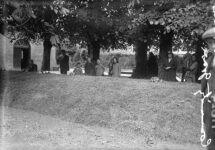
Immediately inside the gates of the Catholic Church of St Bartholomew in the village of Dromcollogher[i], Co. Limerick there is a strikingly-tall, finely-carved, limestone Celtic cross marking a very large rectangular communal grave in which lie the remains of forty-six people. The inscription, taking up three sides of the base of the cross, records in harrowing detail their names and ages as well as those of two other local people, who are buried elsewhere. There are no individual dates of death recorded because all of the forty-eight people were the victims of a devastating fire during a hastily arranged film show in the village on a balmy autumn Sunday evening in early September 1926. A small, simple limestone plaque, inserted on the outside of the boundary wall of the churchyard, records the disaster pithily and starkly: ‘The Cross behind the wall is sacred to the memory of the persons who lost their lives in the calamitous burning on the 5 Sept 1926’. ‘The burning’ was the term always used in the locality afterwards when the terrible event was, and then only rarely, recalled or even mentioned. lt was as if the event was too terrible for words or perhaps no words were necessary, or adequate or even possible. Details of the disaster were reported in newspapers and magazines throughout Ireland, Britain, Europe, the United States and Australia. It was the worst such fatality in Ireland until the Dublin city Stardust fire of 1981, which was strangely to have exactly the same death toll.

[i] Dromcolliher is the official version of the name though the variations, Dromcollogher and Drumcollogher are more popular locally. The signposts on each of the main approach roads to the town give different spellings. It is an Anglicisation of Drom Collchaille, meaning the ridge of the hazel wood. The name is first recorded in the Book of Leinster in the twelfth century, Art Ó Maolfabhail (eag.). Logainmneacha na hÉireann lmleabhar: I Contae Luimnigh (Baile Átha Cliath, 1990) 1gh. 162.

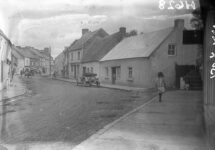
In 1926 Dromcollogher was a village or small town[i] noted for its monthly fairs serving the farmers of its fertile rural hinterland[ii]. It also possessed nearly fifty licensed premises whose trade arose from, and largely depended on, the fairs. Though a strategically important settlement from medieval times, it developed in the early seventeenth century under the patronage of the Courtney family, earls of Devon, who had acquired the area in the aftermath of the Desmond Rebellion and Munster plantation and who recognised its importance on the periphery of their estates. Its diamond shaped centre[iii] and radiating roads still testify to this expansion. It had become more widely known in the late-nineteenth century due to the popularity of an ambiguously complimentary song by Percy French[iv]. It achieved further notice as the location of the first co-operative creamery in Ireland in 1889[v]. During the War of Independence three men died while attempting to burn the local courthouse and a young RIC constable was killed by the local IRA as he came from the barracks to shop in the square.

[i] There is no clear definition of either term and local usage varies.

[ii] In the 1926 census taken 18 April 1926 the town had 442 inhabitants listed. Ten years later the figure was 457.

[iii] Popularly if inaccurately called the Square.

[iv] Composed when the author was staying in the town visiting his brother who was a tutor to the family of Lord Muskerry at nearby Springfield Castle. It has little literary or musical merit and must be considered one of French’s weakest compositions. Though titled simply Dromcollogher, it is usually called by a line in the song ‘there’s only one street in Dromcollogher’ somewhat to the chagrin of local people who correctly point to its four streets and impressive square, not to mention its location at the junction of no less than six roads.

[v] Established by W. L. Stokes of the British Co-operative Wholesale Society and Robert Gibson, a butter buyer and not by Horace Plunkett as is frequently stated.

William Forde was born in 1896, the illegitimate son of Ellen Forde a local woman from the area known as the Pike, named as the road leading from the square divided there into two ‘prongs, one leading to Charleville the other to Buttevant. In the 1901 census Ellen gave her age as 30 years and her occupation as ‘dealer’. She lived with her son and her father, Benjamin, a tailor, aged 60[i] who was a widower. In 1926, when she was aged 55 and still unmarried, she operated a small sweetshop called locally ‘the widow’s shop’ either for the sake of decorum, as most of her customers were children, or perhaps with a touch of irony. That certainly seems to be the case with her son’s nickname, ‘Baby’ both in relation to his surname and the fact that he operated a garage and hackney car business. He had a strong entrepreneurial streak, derived perhaps from a need to prove himself in a small community where the taint, and often the taunt, of illegitimacy were ever-present.

In addition, he suffered from a physical deformity, being a hunchback. It is claimed locally that he used to boast that he would become so successful that he ‘would set Dromcollogher on fire’ though this may be apocryphal. In the summer of 1926, aged 30, he conceived the idea of going into the cinema business. This decision was probably stimulated by the fact that four or five film shows had been held in the village earlier in the year[ii]. These had been held in the village hall in Church Street and had attracted significant support. This seemed to Forde to be an ideal opportunity for a local man to get involved in a new enterprise offering great potential.

To pursue his plans, he went to Cork city where he was put in contact with a projectionist at the Assembly Rooms cinema[iii] who also, as a sideline, gave film shows in local areas. This man, Patrick Downing, bought a second-hand cinematograph machine for Forde and agreed to help him establish his business as Forde had no technical competence in this field and lacked the physical strength necessary as the old machine required manual turning by hand to operate it. Downing brought the machine to Dromcollogher in late August. He later claimed that he stressed the flammable nature of film and even burned a small piece in Forde’s garage to show this, a claim which Forde was to deny. They organised a trial performance on Friday 27 August, which proved successful, and Forde made the fateful decision to go ahead with his new business venture and have a public performance on Sunday 5 September in the local hall.

[i] In 1911 Benjamin gave his age as 80 while Ellen does not list any occupation. Her son’s age is given correctly as 5 in 1901 but incorrectly as 13 in 1911.

[ii] At least three had been given by the Hurley family, one by a Mr Hayes from Kilmallock and another by a man named O’Gorman and also some in previous years it would appear: precise details are not available but it is clear that such performances were not a new experience as has sometimes been claimed.

[iii] Located on the South Mall. Downing lived at 42 MacCurtain Street.

This building, essentially a store with a partially floored upper storey, was located in Church Street, a short, narrow thoroughfare which curved gently from the Square to the junction of the roads leading to Tullylease and Broadford, at which point the Catholic Church was situated and gave the street its name. The structure had been bought by a local man, Patrick Brennan in 1920 for £350 to serve as a store for building materials, mainly timber and glass, for his hardware business. The front wall was made of timber and corrugated zinc while the other walls were of stone. It had a large roller door and a smaller swing door and its floor area measured 50 feet x 30 feet, 6 inches. There was a series of wooden pillars down the centre, which supported the floor of the upper storey. This section had been converted into a hall. A wooden partition, six feet high, leaving a vacant space above to the roof, had been erected down the centre from the front wall, ending about 9′ from the back wall at which point it formed a right angle to meet the south wall. This had been done to create a small ‘dressing room’ [9 feet x 15 feet, 6 inches] at the right-hand corner for the dances, concerts and theatrical shows, which were held frequently in the hall. The actual auditorium therefore was 50 feet long by 15 feet wide. The left wall had timber wainscoting. Access to the upper storey was via a timber ladder, which had been fixed permanently to the outside of the building and provided with a banister. The door, which was the only entrance or exit, was about three and a half feet wide and six feet in height. There was one broken and patched window on the street end and two windows at the back: one in the hall itself and one in the dressing room, each 3½’ x 2½’ and 1½’ from the floor. Both had light bars attached on the outside.

There is contradictory evidence about these bars: John Gleeson, one of the survivors of the fire, said that when a dance was held in the Hall ‘in the time of the Black and Tans’ he himself had removed ‘three of the four bars’ in order to get in some benches. In another version it is stated that the bars had been sawn through to facilitate a speedy escape of IRA men who used to meet in the hall during the War of Independence[i]. It seems clear that, while they were a barrier, they could relatively easily be prised apart. The oval-shaped roof was constructed of timber and felt and would appear to have contained a small skylight[ii]. The structure was clearly quite unsuitable for use as a hall for public gatherings, having a narrow, steep ladder/stairs, lacking adequate exits and being constructed of materials that were easily combustible. It had, amazingly, also housed sittings of the local district court, pending the rebuilding of the courthouse, which had been burned in June 1920 by the IRA[iii]. There was no electric lighting, no provision of any kind for firefighting and the building was not insured.

No official concerns appear to have been raised about the potential dangers of the venue nor had the Guards raised any objections or enquired about fire precautions when the film shows began in previous years even though these contravened the 1909 Cinematograph Act. The local Garda sergeant, James Long[iv] later justified this on the basis that the shows were conducted by experienced men like the Hurley family who he felt confident did not need such reminders.

After the tragedy J. J. Hurley wrote of his happy memories of showing films in that hall in the village:

We arrive by motor about 6 o’clock, the show is advertised to begin at 8. When we arrive in the village all heads are out of doors, little boys and girls race after the car, on to the hall. They follow us in and watch us fitting up and seem to take a great interest in what we do. The machine, which is placed in the centre of the floor, comes in for special attention. The ‘Violin Cello’ (the big fiddle) as they call it, is another wonder. A little chap whispers [to] me ‘have you Charlie Chaplin, sir,’ etc.
At 7.30 we open and they troop in, up the wooden steps, old men and women, boys and girls, and children, all dressed in their best, as it’s a holiday night (St. Patrick’s). There’s a hum of merry laughter and conversation, all new arrivals get a cheer. The village wit is there, he gets a big reception on his arrival. He says something droll and there’s a roar of laughter. A girl commences to sing and she can sing, and everyone joins the chorus. When the orchestra plays popular airs they all sing[v]. There’s silence during the pathetic parts of drama, and a mighty cheer at anything exciting. The hearty laughter at the comics would do one good to hear. All titles (i.e. reading matter on screen) are read loudly by all. They cheer and clap at the finish, and troop out of the hall, laughing and joking[vi].

When the sergeant learned that Forde intended to use the hall for this purpose however there was a different approach. Forde and Long had not been on speaking terms for the previous year and no doubt the Sergeant’s admonitions were not well received by Forde who may have felt this was a vindictive attitude towards him and his plans given that the hall bad been used not only for previous film shows but for many years as a venue for entertainments of all kinds. He admitted later that Long had pointed out what was needed in terms of exits and firefighting apparatus such as buckets of sand and water but claimed that he thought it was the responsibility of the owner of the hall to provide these. He also conceded that he had not mentioned this to Brennan, no doubt fearing that he would then be refused permission to use the venue. Brennan had also been warned by Long that if he allowed more than six film performances in the hall, he would need to obtain a licence from the County Council under the terms of the Act.[vii]

Forde’s use of the hall appears to have been very casual. He had held the trial run there on Friday 27 August, at which Sergeant Long was present,[viii] and on Wednesday 1 September asked Brennan for permission to use it on the following Sunday night. At that stage a travelling theatre company had a show there and Brennan said he was not sure if it would be free. There was no further contact between them but on Friday Forde decided to go ahead on Sunday, having presumably established that it would now be free and on the Sunday he obtained the key from an employee of Brennan’s, a man named White. No mention is made in any of the sources about payment, if any, for the use of the hall. Word was sent to Downing in Cork who then obtained the films, at relatively short notice.

Downing travelled from Cork on Sunday 5 September and arrived in Dromcollogher in early afternoon. In addition to the rolls of film[ix] he brought three electric lamps, two of which he gave to Forde.[x] These were to be used to provide light for the hall and were to be run from a dynamo placed on a lorry, parked on the street outside the hall, which would also provide power for the projector. The current was brought into the hall by two wire cables, passed through the broken and patched front upstairs window. When the hall was being prepared for the show later that evening, it was found that only one of the lamps was working[xi] and this was placed in the centre of the hall. Downing later stated that he had offered to move this light to the door but Forde told him ‘not to bother’. This was to have fatal consequences as Forde instead used candles to provide light in this position. In another fateful decision Downing’s suggestion that the projector be placed towards the far end of the hall with the screen hung on the front wall was not followed. If this had been done, the audience would more likely have fled towards the exit rather than, as happened, some of them retreating to the rear of the hall.

[i] Cork Examiner, 8 Sept. 1926.

[ii] Based on oral testimony that Jack Irwin, uncle of the author. escaped through it. It is not mentioned in the official description of the building or in newspaper reports.

[iii] Three men lost their lives when they were trapped within the building having set it alight with petrol on 20 June 1920.

[iv] A WWI veteran, he had been stationed in the village since September 1923.

[v] There is no reference to any musical accompaniment on the night of the tragedy.

[vi] Letter in Cork Examiner 16 Sept 1926. He mentions that these shows took place ‘a few years ago’ indicating that Forde was merely trying to continue a long-established practice of using the hall to show films without any concerns being expressed about the dangers involved.

[vii] Because there had not been that number, the Sergeant felt that he had no authority to prevent the show going ahead, despite the failure to provide the firefighting equipment.

[viii] lt is not clear who else was present on that occasion, very likely the two young men, Willie Quirke and Batt Barry, mentioned as helping to operate the projector on the night of the disaster. Downing also mentioned that he had advised a man named Gleeson who would assist Forde. Long was not there in his official capacity as he was on leave and he later confirmed that others were also there though he did not indicate how many.

[ix] Either five or six, there is conflicting evidence on this.

[x] Forde, in his evidence, said there were four lamps.

[xi] Downing claimed that the filaments had been broken while in Forde’s custody.

The popular belief, constantly repeated over the years, that the main film being shown during the tragedy was ‘The Ten Commandments’ almost certainly derives from contemporary newspaper reports.[i] A survivor in Croom hospital, John Gleeson, the parish clerk, was quoted as saying that the first film was ‘a cowboy one’ and the second ‘a big picture, The Ten Commandments.’ Shortly after these reports appeared the Dublin manager of the Famous Lasky Film Services [FLFS] pointed out that this was impossible:

In several of the accounts published of the lamentable disaster at Drumcollogher, it is stated that the film which was being shown was ‘The Ten Commandments’. FLFS own this film, of which there are only four copies in Ireland. Three of these were at that time in our vaults, the fourth then being in Newtownards. It is obvious therefore that the film in question could not have been at Drumcollogher.[ii]

In the 1970s Barney Keating, a Newcastle West based bank manager, in the course of his research on the tragedy sought to find out what films were involved. Based on statements in the newspapers that Downing used films shown in the Assembly Rooms, his Cork place of employment as assistant projectionist, before their despatch back to Dublin on Sunday, which would be facilitated by access to the nearby railway station in Charleville, Keating examined contemporary newspaper listings for the films shown the previous week. He then confidently declared that the films shown in Dromcollogher were ‘The White Outlaw’ a cowboy film starring Jack Hoxie and Scout the Wonder Horse and a supporting film, a two-reel comedy ‘Baby be Good’.[iii]

However, a letter written by the man who gave the films to Downing on the fateful Saturday tells a different story. William S. Spencer writing to the late Charles Wall of Dromcollogher[iv] stated that he was certain that the films were The Decoy[v] and False Alarm.[vi] This is confirmed by the report of the tragedy in Time Magazine which mentions that the first film shown was The Decoy.[vii]

[i] Cork Examiner, 9 Sept 1926.

[ii] Irish Times, 17 Sept 1926.

[iii] Barney Keating, ‘The Dromcollogher Cinema Tragedy”, The Annual Observer (1980) pp 34-7.

[iv] I am grateful to James Wall for this information.

[v] Directed by William Garwood and released in 1916.

[vi] One-reel animation film directed by Dave Fleischer 1923.

[vii] ‘One William Ford, storekeeper in the village of Drumcollogher, County Limerick, welcomed to the musty loft of his barn last week a crowd of eager Irish peasants who climbed up the single rickety ladder, sat down in rapt expectance of Drumcollogher’s first cinema show, a drama called The Decoy’. Time Magazine, 20 Sept. 1926, pp 11-12. https://time.com/vault/issue/1926-09-20/page/13/ (article comments that the tragedy prompted the first ever message of sympathy from the Northern Ireland government to the Irish Free State).

The film show was scheduled to begin at 9.00. The timing was arranged both to avoid clashing with benediction in the nearby church and thus possibly arouse the anger of the formidable parish priest, John Canon Begley who dominated the parish both by his strong personality and the general deference accorded to priests at that time and also perhaps to entice the people leaving the church to attend the show. In addition, most people still operated by Old Time so that they would have regarded it as the normal time for such entertainment to start.

At least 150 people, possibly more, climbed the narrow ladder/stairs and paid the entrance fee of nine pence to Forde who was standing at a table, placed at an angle, just inside the door on which he had placed two lighted candles, so that he could see that the correct coins were paid. Most of the audience were from the village and parish of Dromcollogher but people from the surrounding areas and some visitors also attended. The majority seem to have been women and children but all ages, gender and classes were represented. Seating in the hall was mainly wooden forms, long bench seats without any back, but due to the large numbers, some simply sat on wooden planks placed on boxes. These were arranged in rows and went right up against the side wall, with the wainscoting on one side and to the wooden partition on the other, leaving a narrow passage about two and a half feet wide down the centre. This space was further encroached on by a bench placed lengthways on the gangway to provide extra seating.

Some young men sat on top of the partition and others stood at the back. It was later claimed to have been the largest audience ever in the hall and without question there was overcrowding. The projector was placed on a small table in the centre of the hall about 15 feet from the door and 12 feet from the larger table inside the door on which the candles were lighting. The reels of film were also on this table, placed about three feet from the lighted candles. Both Sergeant Long and one of his assistants, Guard Davis, were on duty in the hall. The latter had been sent in earlier by the Sergeant to prevent horseplay among young men, which had been a feature of entertainments there in the past. Long stood near the back, leaning against the table, so that, he later claimed, he would be close to the films with the lighted candle nearby but he apparently neither questioned this procedure nor did he see the film go on fire. He had extinguished one candle when it burnt low but not the other one as there would then be no light to the door and he did not think it a danger. He was engaged in conversation with a visitor from Cork city, Mr F. E. Benson,[i] and was unaware of any problem until he felt heat at his back.

There were five or six reels of film in all, which should have been in protective metal cases but had been brought from Cork without these. No clear explanation for this was given but it would appear to be for ease of transport. Downing testified that he brought them in an asbestos lined bag. He later stated that this was due to the short notice he had received that the show was going ahead. The suggestion that the cases were left behind to disguise the fact that Downing had taken the films from his place of employment without permission seems to have no basis.

In the event, as was usual in rural Ireland, the show did not begin on time – the first film began to be shown around 9.30. During the showing of this short film, Downing had allowed a local young man, Willie Quirke, to operate the projector by turning the wheel.[ii] This seems to be the basis of the rumour that Downing was not in the hall when the fire broke out. This was raised by a member of the jury at the subsequent inquest.[iii] Interviewed in 1980 Mrs Ann Gleeson, a survivor, insisted that both he and Forde ‘were down in the West End hotel drinking the health of a visiting Yank’.[iv] All the evidence available contradicts this. While the unskilled activity of turning a wheel could be left to Quirke, he would not have the experience to identify the correct reels of film or the ability to load them on the projector.[v] The issue of whether Downing was fully sober was also raised at the inquest. Long affirmed that he was, both from his own observation of him and from subsequent enquiries, which revealed that the only drink he had before the show was a bottle of soda water.[vi]

When the first film had finished and one of the reels of the main film was being placed in the projection machine the disaster happened. At this stage Downing had taken control again. These reels were found not to be in the correct order and Downing had taken all of them out of the asbestos-lined bag in which they bad been stored. Thus, all the reels were lying unprotected on the table.[vii] At about ten minutes to ten, one of these went on fire. The circumstances in which this happened were never clarified. At the inquest, one of those present, John O’Brien, testified to seeing the candle fall over and set the film on fire.[viii] As the candle was only held in place by its own grease smeared on the table, it could easily be overturned. Sergeant Long initially didn’t believe that the candle caused the fire, believing that it either resulted from a spark from the cables leading from the dynamo outside to the projector, which passed near the table, or that a lighted cigarette end had ignited the film.[ix] However it is now felt that, on the balance of all probabilities, the overturned candle was the immediate cause of the fire.

Whatever happened, at that initial stage the tragedy could almost certainly have been avoided. Both Downing and Sergeant Long knew that by smothering the flames the fire could have easily been extinguished and both attempted to do this, Downing with his hands and Long using his cap. Downing later testified ‘I was working the machine when I looked around and saw a glare on the table, I immediately cut off the current from the machine, and this automatically lit up the hall. I ran over and just as I got to the table, I clapped my bands on the burning film.’ Two reels of film were on fire at that stage but ‘unfortunately someone came along and hit the burning film with a cap and the flame went on to the other films’. This action was corroborated by other witnesses who saw the sparks spread to the other reels, which then caught fire.[x]

Downing immediately shouted to the audience to remain seated which initially they did. At that stage the Sergeant kicked the first reel on to the floor, which disastrously had the effect of setting the floor on fire. The flames spread rapidly, along the floor, to the wainscoting and the roof creating a dense mass of smoke and fumes. There was then a panic to escape: about two thirds of the audience rushed for the narrow exit door and escaped though some obtained burns and minor injuries. In the rush the original burning reel was carried out the door by Long where it came to rest on the lowest rung of the ladder, setting it on fire. The remaining one third of the audience fled from the fire towards the small dressing room at the far end of the hall, either in panic or because they were told to.[xi] The two windows in this rear wall provided a potential escape route. There were the iron bars on the outside of each window but these were quickly prised apart. A number of people escaped in this way. Cocks of hay in the garden immediately outside the windows caught fire and this seems to have prevented some of the terrified people from escaping, as they felt trapped between two sources of fire. However, within a short time a woman became stuck in the window of the dressing room cutting off this escape route. It would probably still have been possible for many to have exited through the door, despite the fact that the ladder was on fire, but the pleas of Guard Davis to follow him through the inferno were not heeded, either through fear or panic. Davis saved himself so it seems clear that escape this way would have still been possible.

The other potential method of exit could have been by knocking down the partition. Guard Davis later said that he attempted to do this without success. If this had happened people would have had to jump about twelve feet to the ground floor but as the sliding door there had been burst open by those outside rescue would have been certain. The testimony of survivors provides a vivid picture of the horror of the event. Charles Wall, a local shopkeeper told reporters:

I was seated in the centre of the hall – I looked back and saw the place alight. I know of course that the films were on fire. What to do at this time I did not know. The operator shouted ‘keep your seats, keep cool’. I then got the impression that the fire would be put out. My wife ran to the end of the hall with some friends. I stopped where I was and she looked around and ran back to me and dragged me to the door. I just got out as the flames were licking the door and we fell down the stairs. There was no chance for anyone else to get out that door. It was an inferno. I was suffocating when I got to the door and l shouted for God’s sake to push ahead.'[xii]

John Gleeson, who was seriously injured, gave an interview from his hospital bed:

I was sitting inside in the hall with my wife about half-way up, a little above the operating machine. I heard a cry and looking around … I then saw a sudden blaze, I remained where I was when the people in the body of the hall all stood up. Although the cry of’ fire’ had gone up, the people in the front of the screen at the top of the hall did not seem to realise that anything was wrong and when the people rushed for the front door I heard the operator shouting to the people to go back that everything was all right. There was a short pause then and I saw flames and some smoke near the door. When the crowd got on their feet the second time they were practically surrounded by flames. Everything happened so quickly that it seemed as if it were but three minutes before the whole hall was in a blaze. The flames in front of the door cut us, at the back of the hall, off from the only exit. I thought of the windows and rushed to the one behind the screen. I knew that there were iron bars on the windows but that they would not be hard to remove. I worked frantically at them while my wife stood by my side. I could feel the heat growing intense. My ears were deafened with the noise and crackle of the flames and burning wood while my eyes and mouth were full of smoke. I got my wife through the window at last and then turned to assist a grey-haired woman whom I heard moaning at my feet. I helped her to the window and pushed her through. I made to help another woman through but quite suddenly the flesh came off my hands in chunks. I looked and saw the flesh all crinkled and shrivelled: yet I had not been touched by the flames. The heat and suffocation were so terrible I then made for the window myself and got through on the rick of hay outside. I then noticed the grey haired woman hanging down with her legs caught in the window. I remember rushing around and getting buckets of water until some men picked me up and took me to a house where I was anointed by Canon Begley and attended to by a doctor, then I fainted.

Mrs Bridget Noonan recounted the experience of her young son and herself being shoved back as they tried to reach the door:

I stood for a while then, not knowing what to do. Although the fire was all around me I caught the little lad by the hand and made a rush for the door. The poor little fellow fell, God help him. He tripped over one of the forms. He fell and got out of my grip. He began to roar and I caught him again and got up near the door. The whole sides of the place were burning and then gripping the little fellow hard, I rushed through the flames and got to the stairs and away, but the little fellow fell. We ran home, because both of us were burned and Tommy was crying. We were brought to hospital soon after.[xiii]

Sadly, her son was later to die from his injuries. Another unnamed survivor was quoted in the Irish Times:

The last picture was just being shown when there was a blaze, just as if a flashlight picture was being taken. Those in front looked around in fright and seeing the blaze they jumped upon their seats. At this time the women and children were screaming … we got jammed in the door and in the rush to get away many people were hurt. As we were getting out we could hear the heartrending screeches of the women and the shouts of the men behind the screen of the fire which was growing in intensity every minute and which prevented us seeing what was happening, also the smoke was getting so thick that although we were at the door and making our way down the ladder it blinded us.[xiv]

Mary Galvin aged 35, interviewed in Croom hospital, said that once the floor caught fire, there was immediate panic, ‘mothers were pulling their children through the window and husbands helping their wives out.’ When she escaped through the window, she fell on one of the hay stacks which were on fire and received her burn injuries from this.[xv] Mary O’Flynn (née O’Donnell) recalled in 2006 how as a young girl of seven she escaped ‘We went out the back window. My mother went out before me. I stood straight up on the windowsill. lt was a nice bit down from the top window but I didn’t have a scratch on me.'[xvi]

Guard John Davis gave a particularly graphic account of what happened:

I grasped two girls and rushed for the exit. Somebody shouted from the door to go back that there was no danger. The two girls were pulled away from me. I rushed over to May O’Brien, my fiancé and we got caught in the crowd in the middle of the hall and went towards the door. A great crowd was struggling there to get out. I then tried to knock down the partition but did not succeed. I shouted to the people at the top to follow my example. I saw a terrible sight where the people were behaving like savage beasts, mauling, tearing and struggling with one another. They were holding one another in frenzied, deadly grip. They were shouting, screaming and fighting. I did not know where the girl was. The crowd had knocked her out of my hands and separated us. By then the hall was a blazing inferno. The smoke was terrible and it was a miracle that I was not suffocated. The crowd at the back were behaving like a hive of beasts – the men knocking down the women and children in their frenzy.[xvii]

Not surprisingly these comments, widely reported in all the newspapers, aroused considerable upset and anger. Denials were issued by President Cosgrave when he attended the funerals:

I would like to add that in some quarters this morning it was reported that women and children had been trampled on in the panic. My enquiries show such statements to have no foundation in fact, and Bishop Keane who said that he did not know the full details but he did think that some of the descriptions which appeared in that morning’s press were imaginative.[xviii]

Understandably there was panic when the fire started. While President Cosgrave refuted rumours of women and children being trampled on, there is compelling evidence that this may indeed have occurred. According to the testimony of a survivor, Pat Vaughan, he was helping Violet Irwin to escape through the window when a man stepped on her and on his hand as he grasped hers with the result that she fell back into hall where she died.[xix] The evidence of Sergeant Long suggests a similar pattern of escape at all costs. On the other hand, men like Timothy Buckley and James Quaid lost their lives through remaining in the building helping others to escape. Bob Aherne, having escaped along with his wife of five months, in returning to try to rescue his mother-in-law Mary Anne O’Callaghan, died along with her. William Savage who had not been in the hall, on the mistaken impression that his sons were there, rushed from his home across the road, in to the blazing building never to emerge. Fr Punch, the local curate, offered the opinion that every man in the communal grave had died trying to save women and children.

In addition to the two guards in the hall, Guard T. Kenny was patrolling the village, while Guard T. Burke saw the fire from his lodgings and a Guard Sexton from Milford also came on the scene. They attempted to rescue people through the windows at the rear but their efforts were hampered by the burning hay cocks. They also tried in vain to free the window in which the body of Mrs Madden had become stuck. They assisted some villagers to break open the door on the ground floor and Sergeant Long had the lorry with the dynamo moved from outside this door. However, nobody managed to escape from the building this way. While it is unlikely, given the speed and intensity of the fire, that it would have been of any help, there was a shortage of water. The town pumps bad been out of order for the previous four months and little water was available from the nearby stream due to the lack of rain that summer.

Within ten to fifteen minutes the roof and the floor collapsed, plunging the victims to the ground. Their remains were found in the south-east corner of the ground floor directly underneath the dressing room. As soon as the intensity of the fire had subsided the guards and some civilians poured water on the bodies to prevent their being burned to ashes. It seems certain that all the victims had already lost consciousness or died from suffocation before their bodies were burned. Forty-six people died immediately while two injured survivors later died in hospital. These were Thomas Noonan, the seven-year-old boy rescued by his mother and James Kirwan, a fifty-year-old labourer. Kirwan who also got stuck in one of the windows was rescued by Guard Kenny. He was extensively burned in the face, throat and hands as well as suffering from shock. It was clear that he would not survive but he lingered on in hospital until 14 September 1926.[xx] Nearly fifty others suffered burns and minor injuries, nine of these were taken to Croom hospital while the rest were treated locally.

Identification of the victims was difficult or impossible in many cases. Watches and jewellery helped relatives in some instances. The watch of James Quaid had stopped at 10 minutes to 10 thus confirming the evidence of witnesses regarding the timing of the disaster. The watch of another victim, Anthony McCarthy, found at the bottom of the heap of dead, was still working while a similar item identified Bob Ahern. A distinctive shoe buckle was recognised by the mother of Violet Irwin. A charred letter in the pocket of Thomas Buckley identified him. Of his brother’s family only Jeremiah was positively identified.

On the following morning, in addition to shock, there was a great deal of anger in the village at what had happened. The Guards ordered that all the public houses remain closed. The windows of Forde’s house were broken and it was placed under Garda protection. For their own safety both Forde and Downing remained in the Garda Station, as it was feared that they would be assaulted if they appeared in public.

[i] He is also referred to as an American visitor in some accounts but his address is given in police reports as 18 South Mall, Cork. He would appear to have come from Cork with Downing as he put up the bail money when the latter was arrested.

[ii] This was probably to train him as the operator for future shows.

[iii] Sergeant Long replied that this was unlikely though he did not categorically deny it. This juror also asked Long for confirmation that Downing was perfectly sober, suggesting that rumours to the contrary had been circulating. When another juror asked if Forde had left the hall, the Coroner intervened to say that this was not of any relevance, as he had no role in showing the films. Forde’s solicitor pointed out that his client had burns on his face and hands.

[iv] Transcript of interview with Theresa Broderick, Dec. 1980. Presumably this was where Downing and Benson were staying.

[v] It may well be the case that he and Forde had a drink before the show with Benson and this coupled with the fact that Quirke briefly operated the projector gave rise to this rumour.

[vi] Cork Examiner, 14 Sept. 1926.

[vii] It is not clear how many reels there were. Long thought there were five or six, one newspaper reported that there were eight. Downing does not seem to have clarified the situation.

[viii] From Kells, Dromcollogher he gave similar evidence at the later trial. On neither occasion did he say how the candle had fallen either through lack of knowledge or unwillingness to implicate anyone.

[ix] Irish Times, 7 Sept. 1926. Cork Examiner, 7 Sept. 1926.

[x] This was a separate incident from the claim that a thrown cap had caused the initial fire though the possibility that such reports became confused cannot be ruled out.

[xi] Irish Times, 7 Sept 1926.

[xii] Irish Independent, 7 Sept. 1926.

[xiii] Cork Examiner, 9 Sept. 1926.

[xiv] Irish Times, 7 Sept. 1926.

[xv] Irish Times, 9 Sept. 1926.

[xvi] Sunday Tribune, March 2006.

[xvii] Ibid.

[xviii] Irish Times, 8 Sept. 1926.

[xix] Cork Examiner, 8 Sept. 1926.

[xx] Irish Times, 16 Sept. 1926. It was decided not to hold an inquest.

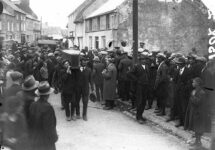
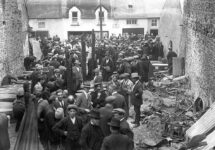
The practical details of burying the victims were an immediate problem. A large public meeting was held in the Square to discuss the possibility of a mass grave, something that seemed inevitable, given the impossibility of identifying most of the victims. A local man offered a site but following a telegram to the Bishop of Limerick, permission was given to have a communal burial plot in the churchyard. Coffins were brought by the army from Newcastle West but these were not sufficient and large timber boxes in which American bacon had been imported were used for some of the dead. One report described them as ‘crudely constructed and of all sizes’, the latter a sad reminder of the number of children who died. On Monday the grim task of taking the remains from the burnt-out building and placing them in the coffins was undertaken. In some cases only skulls were clearly distinguishable. ln the evening the coffins were removed to the churchyard where they remained outside overnight, laid in rows on either side of the pathway into the church.

The funeral Mass, at 11.00am (old time) on Tuesday morning, was attended by President W. T. Cosgrave. The celebrant was the son of victim Mary Anne O’Callaghan, Fr Daniel O’Callaghan who was a curate of the diocese of Limerick based in Askeaton while another son, Fr Patrick O’Callaghan, curate in St Patrick’s parish in the city was deacon. Canon Begley presided and over fifty priests from the diocese of Limerick as well as many from surrounding North Cork parishes were present, seated in special pews in the nave of the church, just outside the altar rails.

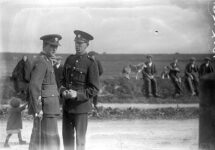
Bishop Keane did not arrive in time for the Mass but blessed the coffins and performed the interment rites in the churchyard. In his address to the assembled mourners he expressed his deepest sympathy however he was aware that it was not through words of his that they looked for their chief consolation. The victims of the disaster, he continued ‘were, if they were to pick them out of the parish, amongst the most upright, conscientious and good living Catholics which could be found.’ His comment that ‘it was well to know that nothing had happened which would prevent their communion with the God who made them’ is not clear but probably referred to their blameless lives. He noted the action of the men who had died saving others and somewhat strangely added ‘I am not going to compliment acts of heroism of that kind. Tt is enough for you to know that Our Divine Lord had said ‘Greater love than this no man hath who lays down his life for his fellow-man’. He appealed to those who had not lost relatives to ‘use every kindly word and perform every kindly deed’ to those not so fortunate ‘to bring balm to their aching hearts and to fill the void that has been made in their lives and hearts, so that in that way charity may live amongst those as it never lived before’. President Cosgrave expressed sentiments similar to that of the bishop, focusing on the acts of heroism, specifically that of Robert Ahern who had returned to the burning building in a vain attempt to rescue his mother-in-law.

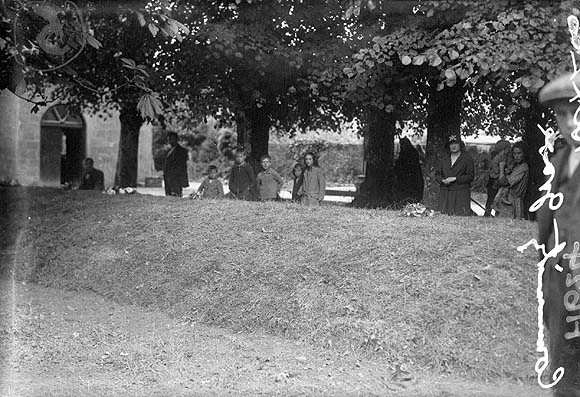
The mass grave was still being dug, largely by volunteers from the nearby parish of Tullylease, as the Mass ended. The complex task of placing forty-five coffins in the grave was overseen by local County Councillor, John Quaid, whose brother James and cousin Violet Irwin were among the victims.[i] She was not buried with the others but removed later that evening for burial in the family plot at Cloncrew cemetery in her native Feenagh parish. This had been insisted upon by her parents despite the vehement objection of Canon Begley and in a final ironic twist, it has been suggested that in fact it was not her body which was removed but that of another young female victim.[ii] As the interments were taking place a brother of Edward Stack[iii] arrived and identified his remains. He asked for the body to remain in the church oven1ight, so that other relatives could arrive from his native place, Duagh, Co Kerry. His body was placed in the communal grave on the following morning. The child Thomas Noonan who died later was buried in Deliga cemetery and when James Kirwan died in Croom hospital in the following week, he too was buried with the other victims in the churchyard. Dozens of men piled up the earth on the grave, which was 30 feet long and 10 feet wide, on Wednesday to a height of 3 feet and covered it with green sods interspersed with floral tributes. The memorial cross later erected over the grave was paid for out of the Relief Fund.

[i] Interview with Lt. Col. William Irwin in 2009 who, as a ten-year-old boy was present.

[ii] Her mother had identified her from a shoe buckle but in the dusk and confusion the body of a girl of similar age may have been taken.

[iii] He was a farm labourer employed by Edmond O’Sullivan of Tulligmacthomas, Dromcollogher.

Canon Begley did not preach at the funeral Mass but his sermon on the following Sunday 12 September[i] was based on the text ‘Through many tribulations we must enter into the kingdom of God.'[ii] He described those killed as ‘the flower of the flock’. He noted that most had been at communion on that day and on the previous First Friday and all were at benediction that night, so ‘God had called those who were prepared to go’. Humans could not scrutinise the ways of the Lord but only submit to his will. The best consolation was that the victims were so good and so prepared and also had the prayers of Catholics all over the world as well as the sympathy of people all over the world from every class and religion. It was also a consolation that the mass grave was in the grounds of the church where people could come to pray. He was careful to emphasise that it was an accident and pointedly remarked that no one was to blame: ‘I will say this much that all those who went there to that hall went there with the best intentions. Whatever happened there was pure accident and no one is to blame. It is a visitation from God. We have now only to bow our heads in silence and submit to the holy will of God and by doing so we will nourish our faith, we will increase our hope and perfect our charity’. He noted that ‘King George and men in exalted positions, both in Great Britain and Ireland have human hearts that throb with sympathy for the poor distressed people of Drumcollogher,’ showing that ‘one touch of nature makes the whole world kin.'[iii]

[i] Limerick Leader, 15 Sept. 1926.

[ii] Acts of the Apostles, Chapter 14, verse 22.

[iii] Quotation from Shakespeare’s Troilus and Cressida, Act III, Scene iii. The popular interpretation of this phrase, as used here, is in fact a misunderstanding or misapplication of its original meaning which was not the idea of universal brotherhood.

While the victims ranged widely in age, more than half were under twenty-five and seventeen were minors, under the age of eighteen. The youngest victims were John Kenny and Thomas Noonan both aged seven. Thomas Barrett and Daniel Fitzgerald were a year older while Mollie Barrett, Bridget Buckley and Margaret Fitzgerald were aged ten. Nora Mary Hannigan, John McAuliffe and Eugene O’Sullivan were eleven years old while Daniel Horan, James Kenny and Bridget Sheehan were twelve. Maurice Harnett was thirteen, Mary Ita Nunan fourteen and Violet Irwin and Mary McAuliffe, both fifteen. The oldest to die was sixty-eight-year-old Mary Turner while six others, Thomas Buckley, Margaret Collins, James Kirwan, Nora Long, Mary Anne O’Callaghan and Patrick O’Donnell, were also in their sixties. Five of those who died were married men, one was a widower and five were single men. Of the women, eight were married, nine were single and three were widows.

One entire household was wiped out: Jeremiah Buckley, a fifty-four-year old National Teacher along with his wife, Ellen (56), daughter Bridie (11), sister-in-law Kate Wall (46) and their maid, Nora Kirwan (18) all perished. Miss Wall was a school inspector in England due to return to work the following week. Jeremiah Buckley’s brother Thomas (61), a retired national teacher also died as did Mary Anne O’Callaghan whose husband had been principal of the local school. The Buckleys were the only married couple among the victims. The sight of the family terrier whining next day outside the empty house was long remembered.[i]

There were two sad cases of the death of a young mother and two children. Mary Barrett (34) died along with her children, Mollie (10) and Tom (14) as did Anne Fitzgerald (38) with her daughter Margaret (11) and son Daniel (8). Equally poignant was the death of Kate McAuliffe (56), her sixteen-year-old daughter Mary and twelve-year-old son John, leaving Florence McAuliffe (53) without his entire family. A similar loss was endured by Jeremiah O’Brien, a disabled sixty-year old who lost his wife Mary (51) and daughter, Nellie (18). Mary Egan (36) left a husband (44) and four children, Mary Barrett (34) a husband (41) and three other children while Anne Fitzgerald was survived by her husband (43) and a thirteen-year-old daughter. Patrick O’Donnell (50), porter at the local branch of the Munster and Leinster Bank, probably stayed in the hall looking for his wife Katie (45) and young daughter Mary (7) unaware that they had escaped through the window.

Ellen Madden (54), a huckster, was the woman who died trapped in the window and who is unfortunately remembered more for blocking an escape route than for the circumstances of her own horrific death. Margaret Collins (60) managed to get through the other window but her feet became caught in the bars and she died hanging in that position. Her sister Kate Collins (59) also died along with Kate’s daughter (22), and their two nieces, Nora (22) and Myra O’Sullivan (21) from Sheshive, a few miles from the village. Among the other victims was Mary O’ Brien (24), the fiancée of Garda John Davis who made frantic but unsuccessful efforts to rescue her.[ii]

Nora Long lived in Church Street with her sister and brother-in-law Patrick Savage, who had a public house. Two of the married men who died also had businesses in Church Street across the road from hall: Bob Aherne (31) was a publican and William Savage a butcher and farmer. Another farmer victim was Jim Quaid from the townland of Clonlara, William Quirke and Anthony McCarthy, single men, were a carpenter and hackney driver respectively.

Nora Mary Hannigan (11) was visiting relatives in Pike Street from her home in London, Violet Irwin (15) lived in the nearby village of Feenagh. Edward Stack, a farm labourer was from Duagh, Co. Kerry. John J. Walsh, a native of Freemount had just taken up the post of principal teacher at Milford National School. His family were still in Co. Galway where he had previously taught. All the other victims were from the parish of Dromcollogher, most lived in the village and ten were from Pike Street.

[i] The family had a shop with a news agency on the Square and the newspapers remained on the street next day until taken in by another shopkeeper, who thereafter retained this coveted and lucrative concession, something frequently mentioned in local oral testimonies about the tragedy.

[ii] Newspapers stories that they were engaged or about to be married were denied by her mother. He was later to marry a sister of one of the survivors, Mrs Anne Gleeson.

The inquest into the deaths was opened at 7.30pm on Monday evening 6 September at the local Courthouse before the Coroner for West Limerick, local G.P. Dr Timothy Hannigan and a jury. He told them that their first duty was to find the cause of death and in that case it was ‘only too obvious’. The poor victims were simply burned to death. lt was also within their province to enquire into the cause that might have led up to death. He stressed that it was not actually necessary for them to find anyone guilty or to blame anybody, adding ‘they were always wiser after the event’. After being sworn in the jury members went down to view the remains of the dead, by now laid out in coffins in the churchyard.

The Civic Guards were represented by Superintendent O’Reilly and Inspector Kenny while a representative of the Industrial Section of the Ministry of Industry and Commerce, Mr. J. Donnelly was also present. Evidence was given both by Forde and Downing. After being cautioned by the Coroner, Forde agreed that he had no experience of cinema work and that no precautions against fire had been taken. There was neither firefighting apparatus nor buckets of water or sand in the room. Having attempted to quench the fire, he said he first went to the end of the hall ‘but could not get out’ and then returned to the door and left that way. It is unclear why, being familiar with the room, he would have gone in the opposite direction to the only exit. He possibly did not wish to give the impression that he had rushed to save his own life as soon as the fire had started.

In his evidence Downing said that as soon as he was aware of the fire behind him, he cut off the current to the machine ‘and this automatically lit up the hall’. Having attempted unsuccessfully to extinguish the flames, be tried to keep the crowd calm by shouting ‘keep cool, keep your seats’ and only left when he thought all the audience had escaped: ‘honestly, whether it was the excitement or not, as true as God is above in Heaven, I thought there was nobody else in the hall when I rushed out myself’. As soon as he was outside and realised people were still trapped he tried to re-enter but was stopped by Sergeant Long; he then helped rescue people at the back windows and his hand was injured when a ladder he was using fell on him. In answer to questions from Superintendent O’Reilly, he agreed that it was his duty to prevent accidents adding ‘when I came down here I did not want to start the thing at all, I did not like the place’.[i] He also acknowledged that he bad not brought the metal cases in which the film reels should be stored. When Downing finished his evidence, the jury heard a brief statement from Mr T.E. Benson who confirmed the testimony of Long and the inquest was then adjourned for a week.

When the inquest resumed at 11.30 on Monday 13 September, Sergeant Long gave detailed evidence and was questioned at length by the State Solicitor who appeared for the Gardaí. Long stressed in particular how, when he learned about five weeks previously that Forde intended to start showing films, he had spoken to him about the necessity for proper precautions against fire. He specifically informed him that buckets of sand and water and a wet blanket should be available. He also discussed exits and their relation to the projector and the requirement for a licence for the hall. He had also raised this issue with Brennan, the owner of the hall and bad also had discussions on two occasions with Downing on his involvement with the proposed venture.

The next witness was an audience member, John O’Brien. He testified that he was about fifteen or twenty feet from the table and was looking towards the door when he saw the candle fall on the table and set fire to the reel of film. He was adamant ‘I have no doubt that it was the flame from the candle set the films on fire’. There is no indication from his evidence on how or why the candle fell and he does not appear to have been questioned on this vital point.

It had been anticipated that there would be evidence from at least ten other survivors and the guards had taken statements during the week from these people. Among those who gave statements were Patrick Carroll, Daniel McCarthy, Patrick Murphy, Delia Sheehy and Andrew Walsh. However, at this point the Coroner and jury stated that they did not require any further evidence and that they would be able to bring in a verdict from what they had already heard. The State Solicitor, in his summing up, strongly urged the jury to bring in a verdict of manslaughter against Forde and Downing. While the Garda authorities felt that some of the jury were so inclined, in the event, after deliberating for about three quarters of an hour, the foreman, local farmer Mr Martin J. Geary PC announced their verdict:

We find that those who lost their lives at the cinema performance on Sunday 5th September 1926 did so through asphyxiation and burning which was caused by a lighted candle falling on exposed films on a table which ignited the hall. We find that the operator, Mr Downing was guilty of negligence in having the films exposed on the table and that there was carelessness on the part of the promoter Mr Forde in leaving a lighted candle on the table. That we tender to the bereaved relatives our heartfelt sympathy and we pray that god may give them strength to bear their affliction.

At the conclusion of the inquest, the Chief Superintendent of the Gardai, after consultation with the State Solicitor, ordered that Downing and Forde be arrested on a charge of manslaughter. Both men were then brought to the barracks where before Martin Geary, the Peace Commissioner they were formally charged that ‘they did feloniously kill and slay William Savage, Church Street, on the night of 5 Sept.'[ii] The police Superintendent Slavin from Newcastlewest confirmed that he was only bringing the charge against the accused in respect of the death of Savage. While this procedure was not explained it was almost certainly related to the fact that his body bad been identified unlike so many others of the victims. Both accused, neither of whom made any response when charged, had legal representation, J.P. Lavan, a Newcastle West solicitor for Forde and B. O’Meara, from Cork for Downing. Sergeant Long’s request for a remand to the next sitting of the district court at Dromcollogher on Friday 1 October was granted. Both accused applied for bail, which was set at £100. When Benson offered to put up the money for Downing he was immediately released. Forde initially failed to find any independent bail and even though his solicitor, Lavan, then offered to do so, it would appear that this was not regarded as acceptable and Forde was taken to Limerick prison that night. However, he was released the following evening having secured the bail and was reported to have left the city for Cork. Patrick Brennan was arrested on the following Saturday 18 September, brought before the Peace Commissioner and remanded on bail of £100 provided by himself with two sureties of £50 each.[iii]

The initial stage of the prosecution of the three men was at the local district court in the afternoon of 1st October.[iv] The State solicitor, J. J. Power opened the case for the prosecution outlining that the three accused were charged with the manslaughter of Anthony McCarthy, Patrick O’Donnell and Daniel Horan. No explanation was given for the change from the earlier name of William Savage but again these were victims whose bodies had been clearly identified.[v] Perhaps because Savage had not been at the show and had voluntarily gone into the burning building it was felt that this would undermine the State’s case. The basis of the charge was that the defendants had caused the deaths due to their criminal neglect in the management of the cinema.

Mr Power applied to have the three men returned for trial, submitting that there was an overwhelming case against Forde and Downing. He acknowledged that the case against Brennan might not be so strong but it should go forward for investigation. Forde’s solicitor argued that his client should not be charged, as it was Downing, as the experienced operator of the show, who was responsible. Deputy District Justice R. L. Tyrell commented that the tragedy would never have taken place unless there had been culpable negligence. The real cause was that the people upon whom the duty of attending to the safeguards required were recklessly negligent. He had no doubt as to the responsibility of Brennan and Forde while any doubt be had in regard to Downing was cleared up because the regulations made him liable to take measures for the safety of the show. He knew all about the danger of exposing the films, which were on the table near the lighted candle. The judge then ruled that a prima facie case had been established against all three and returned them for trial to the Limerick Circuit Court.

Their trial for manslaughter eventually took place at the Central Criminal Court in Dublin in November 1926 before Mr Justice O’Byrne and a jury. Two King’s Counsel, Mr Carrigan and Mr White prosecuted for the State. The defendants each had separate barristers, Michael Binchy for Brennan, Joseph Healy for Forde and J. McCarthy for Downing. In his evidence Forde quite clearly tried to lay the blame for what had happened on Downing. Presumably this was on the advice of his legal team as up to this point they seemed to remain in touch: both are mentioned as arriving together from Cork for the initial court hearing.[vi] He denied that he had been warned sufficiently about the inflammable nature of film and in particular that Downing had burned a small piece of film in his garage to demonstrate this. He stressed that he had placed lighted candles on the table only because only one of the electric lamps brought by Downing were put up. There were no films on the table when he lit the candles and it was Downing who placed them there subsequently. He further denied that any of the lamps were broken or that he had refused an offer to put the one working Light near the door. Brennan in his evidence merely outlined the circumstances in which Forde had asked for the use of the hall and in effect confirmed Forde’s testimony that there was no formal arrangement between them and that it was his assistant, Mr White, who gave the key to Forde on the Sunday evening.

Downing contradicted Forde’s evidence on a number of important points. He insisted the filaments in two of the lamps were broken when Forde gave them to him with the clear implication that this had happened while they were in his custody. He also repeated that Forde had said ‘don’t bother’ when he offered to place the remaining light near the door. His suggestion that the screen be on the front wall with the machine towards the rear of the hall was ignored. He outlined the circumstances in which the fire had begun, his foiled efforts to extinguish the flames and his belief, due to the thick smoke, that everyone had got out safely when he left the hall.

In their summing up, the barristers made specific arguments in favour of their clients. In the case of Forde, it was that ‘he should be judged by the standards of Dromcollogher’ and not by those in cinemas in the cities. For Brennan the basic defence was that no one had requested him to provide firefighting appliances or to have more than one exit. Downing’s barrister argued that what occurred that night was no different from the practice already well-established of holding film shows in the hall with ‘the tacit, if not the active approval of the State as represented by the Sergeant in charge.'[vii] His client had done his best in the circumstances in which he found himself, having already alerted those involved to the potential danger of films.

Mr Justice O’Byrne in his summing up and address to the jury strongly rejected the argument that the Sergeant had in effect authorised the showing of the films; what happened was clearly against the law and therefore could not be sanctioned by any Garda. He also dismissed the argument that there should be a different standard in terms of public safely for a small village from that of towns or cities. He declared that it was no defence for any of the three accused to say that the others were equally to blame. He then explained the difference between a charge of negligence and one of criminal negligence. The former was a breach of duty, a failure to take care, an omission to do something that ought to have been done. He cautioned the jury members to base their findings only on the evidence presented to court and not to be influenced by the enormity of the tragedy and the widespread publicity it had attracted. They must determine what a reasonable man would have done in the particular circumstances of this case and if the actions of any of the accused fell short of that standard then he was negligent. But this was not sufficient to sustain an indictment for manslaughter. In order to return such a verdict, the deaths must have been caused by criminal negligence, which was a reckless disregard for the lives or safety of others.

After deliberating for over an hour the jury found Brennan not guilty. They reported that they disagreed in the case of the other two defendants. The judge sent them back again and after a further forty minutes deliberation, the foreman announced that they still could not reach agreement. Forde and Downing were then allowed to leave on continuing bail. In February 1927 the Central Criminal Court was informed by Counsel for the Chief State Solicitor that it had been decided to enter a nolle prosequi against Forde and Downing ‘as it had been agreed that the object of the prosecution had been attained by the warning publicly given by the steps taken.'[viii]

[i] Presumably when he conducted the trial run on 27 August.

[ii] Limerick Leader, 15 Sept. 1926.

[iii] Irish Times, 20 September 1926.

[iv] Irish Times, 2 October 1926. The report incorrectly stated that those charged with manslaughter were the ‘proprietor of the cinema’, operator and landlord of the hall – Forde of course was not the proprietor. It also gave the death toll as forty-nine.

[v] Horan’s body was identified by his father William who stated that it was only partly burned. Indeed, evidence was given by John Noonan that he saw Horan trying to escape through one of the windows but in the panic he was pulled back into the flames by someone inside attempting to get out.

[vi] Local hostility made it risky for Forde to remain in his home.

[vii] Cork Examiner, 20 Nov. 1926.

[viii] Irish Times, 12 Feb. 1927.

A relief fund was set up immediately by the government at the initiative of President Cosgrave who announced its membership on Thursday 9 September. lt consisted of two TDs, Thomas Johnson, Labour party and leader of the opposition, and Eamonn J. Duggan, Cumann na nGaedheal, Willoughby J. Hamilton, the President of the Stock Exchange, Mr A.R.S. Nutting, the President of the Irish Banks’ Standing Committee, and prominent businessmen and public figures, Sir John Arnott, Dr Lombard Murphy, Sir Walter Nugent, Laurence O’Neill, Sir Joseph Glynn and C.E. McConnell. The latter three men were appointed as Honorary Secretaries. A temporary office was opened at Government Buildings and the Hon Secretaries came to Dromcollogher to compile a preliminary report.[i] Already a local committee had been formed under the direction of the curate, Fr Edmund Punch, which had drawn up accounts for the funeral expenses, which amounted to, between £350 and £400. They also compiled lists of those who had died or been seriously injured and of the dependants who were in most need of help. Following this, John Healy, a retired civil servant with the Office Public works was appointed executive secretary and he then spent several days in the village where he visited all the bereaved families.[ii]

Ba láithreach, fairsing agus flaithiúil é an freagra a tharraing an achainí. Tháinig tabhartais isteach ó gach cearn d’oileán na hÉireann, thuaidh agus theas, ón RA, ón Eoraip agus Meiriceá Thuaidh. Tháinig siad ó ghnólachtaí, ó chomhlachtaí agus ó dhaoine aonair. Numerous shows and functions were organised to raise money and local groups in factories, shops and organisations made collections. Sports clubs were also active and generous. Among the first offers of help was one from the American entertainer Will Rogers, reputed to be one of the highest paid performers in the world, who was then in London as part of a European tour. He changed his itinerary to include Dublin and held a concert as the La Scala theatre, which was given free by the owner, George P. Fleming. The concert which also featured the No 1 Army Band and the soprano May Doyle was attended by over two thousand people and raised £363.10.6. from which sum no deductions for any expenses were taken. Rogers also gave a personal donation of £100 and arranged publicity for the appeal fund in the USA. A later concert in the Olympia theatre, Dublin raised £101.4.7.

The largest donation received was £500 from the Arthur Guinness Co. while Jameson Distillers and Independent Newspapers contributed £250 each. The Irish Banks’ Standing Committee collected £210.10.0. from their members. Sums of £200 were sent by Tim Healy, the Governor-General of the Irish Free State, Clery’s Department Store, Dublin and Ranjitsinhji Vibhaji, the Jam Sahib maharaja of the Indian state of Nawnagar. The latter, better known as Ranji, was a famous cricket player, who usually spent the summer at his Irish home, Ballynahinch Castle in Connemara. Tobacco companies John Player and W. & O. Wills and Maguire and Patterson Matches each gave £100 as did Murphy’s brewery in Cork and the Allied Irish Artists Corporation. Jacobs biscuits provided £105 while their employees gave £53.2.6. from their own resources. Other generous individual donors were Major Dermot McCalmont, Mount Juliet, Kilkenny (£105), James J. Phelan of Boston, Thomas Byrne of Chicago and the Cork TD, Andrew O’Shaughnessy (£100 each). Similar sums were donated by Count John McCormack, Lord Iveagh, Sir John Arnott and Mrs Beulah Croker, widow of the Tammany Hall politician, Richard ‘Boss’ Croker as well as by the Irish Turf Club and Siemens Schuckert Ltd.[iii] A soccer match at Dalymount Park on 18 September raised £276.13.0., while the Gardaí made a number of collections which amounted to nearly £500. The Dublin Jewish community raised £77.12.0. from their members.

The effect of the tragedy on the general public was evident by the large number of both large and more modest donations including some anonymous ones such as half a crown ‘widow’s mite’ and a shilling from a schoolboy. However, this generosity was apparently attempted to be exploited and the Relief Fund Committee issued a warning about unauthorised collectors. lt advised that any local fund raising should be carefully organised and monitored.

The Limerick Leader newspaper originally opened its own fund, asking intending subscribers to send contributions to their office and promising that the names and addresses of all who subscribed would be published with the amounts contributed. They explained that their purpose was to facilitate those who could only afford to give small subscriptions and might not wish to send them to the Central Fund in Dublin.[iv] However, at the request of the Mayor of Limerick, Councillor Paul A. O’Brien, who had established a formal one for the city this was cancelled. The Mayor’s fund had been decided upon at a public meeting in the Town Hall on 16 September. It was noted that while the National Relief Fund was getting numerous donations ‘some people were not, however, satisfied with the line of action adopted and thought that Limerick city and county should do its part independently’.[v] Earlier at a meeting of the Harbour Board it had been stressed that unless there was a specific Limerick fund, subscriptions from there would go directly to the National Fund ‘for which Limerick should get the benefit’.[vi] The response in Limerick, as elsewhere was generous: Bannatyne Mills donated £100 and Bishop Keane £50, the local branch of the British Legion ten guineas and Lord Dunraven £10. The city fund eventually raised £645.[vii]

At a meeting of Relief Fund Committee in early October it was revealed that over £12,000 had been subscribed. £3,000 of this had been sent directly to Canon Begley or raised by the Cork Examiner and the fund set up by the Mayor of Limerick. The Committee decided to close the fund on 9 October.[viii] In a letter of thanks in the newspapers, President Cosgrave gave a figure of £9,800 which seems to relate only to the government fund and noted that the committee now had the task of preparing a scheme for its distribution.[ix] Trustees under the chairmanship of General Richard Mulcahy[x] were appointed to administer the fund. Two members of the Relief Fund Committee, Thomas Johnson and Charles Edward McConnell, an advertising agency owner, continued as trustees and they were joined by Canon Begley initially and after his transfer by the incumbent parish priest of Dromcollogher at any given time. The accountants for the fund were Messrs Kean & Co., Westmoreland Street, Dublin.[xi]

When the first payments began in 1927 the final sum raised had reached the impressive total of £16,787. In the first year a total of £3,457 was distributed. Payments were made in varying amounts, some as lump sums, but most sent in instalments every quarter, until the 1950s, to the dependants or relatives of the victims and to some of the injured survivors.

By 1954 there were still eleven people receiving payments from the fund when they were notified that it was due to be closed. This figure had reduced to nine by 1958 when all payments ended.

[i] Irish Times, 13 Sept. 1926.

[ii] Limerick Leader, 9 Oct. 1926.

[iii] The German firm then starting work on the Shannon Scheme at Ardnacrusha.

[iv] Limerick Leader, 8 Sept. 1926.

[v] Limerick Chronicle, 16 Sept. 1926.

[vi] Limerick Leader, 13 Sept. 1926.

[vii] Limerick Leader, 30 Oct. 1926.

[viii] Limerick Chronicle, 7 Oct. 1926.

[ix] Irish Times, 9 October 1926.

[x] Former Minister for Defence, then out of office having resigned due to the army mutiny episode of March 1924. He was reappointed to the Cabinet as Minister for Defence in March 1927 but continued to act as chair of the Fund Trustees.

[xi] Accounts of the Drumcollogher Relief Fund, 1926-58 (N.L.I. Thomas Johnson Papers MS 17158).

William Forde returned to live in Dromcollogher but faced continuing hostility as he was blamed for causing the tragedy. The windows of the house in which he lived with his mother were intermittently broken by stones at night. More distressingly, parents did not allow their children to buy sweets in the shop and his garage business was similarly shunned. In the autumn of 1927 he emigrated to Australia. Little was heard of him until the report of his death was published in April 1929. While some people believed he had committed suicide, this would appear not to have been the case. With two others, Forde was engaged in trapping and poisoning rabbits in a place called Yetman in New South Wales. He was the cook for the group and in making bread he added the arsenic used for killing the rabbits instead of baking soda. When they became violently ill, the mistake was discovered and one of them walked over two miles for help. All three were taken to hospital over thirty miles away by a policeman. They were admitted at 11.15pm and Forde died at 6.00am on the following morning. The two others, younger and stronger, survived.[i] However, a local version of the circumstances of his death is quite different. In this account he was travelling alone to the west coast of Australia and had camped for the night. Having made some coffee, he added arsenic to it instead of sugar and was found dead by the ashes of his campfire.[ii] How this incorrect account of his demise arose is unclear but it obviously allowed the suicide interpretation to be believed by some.

Patrick Downing apparently lost his job at the Assembly Rooms due to the tragedy. His injuries in trying to rescue people were also serious and be developed gangrene poisoning. According to the research of Barney Keating, he secured employment again, after his trial for manslaughter, in another Cork cinema. He is believed to have died from cancer in St Luke’s hospital in Cork sometime in the 1950s. Patrick Brennan continued to live locally until his death in the late 1960s: neither he nor the man believed to have knocked over the candle appear, unlike the unfortunate Forde, to have been blamed or subjected to any hostility.

For Canon Begley there was an unsettling sequel. One evening about two weeks after the fire, a local man was accosted by the priest as he tried to climb over the fence which had been placed in front of the burned-out shell of the hall. He said he wanted to search for his sister’s wedding ring but Canon Begley ordered him to leave.[iii] Heated words followed and eventually the man struck the Canon, who reportedly responded by saying ‘in the future that hand will do far more serious damage than strike a priest of God’. A few months later this man got into an argument with a friend while playing cards and under the influence of drink killed him in the resultant brawl. Many viewed this as the fulfilment of a curse placed by the priest on him. Canon Begley was then transferred from the parish to Kilmallock and would appear not to have been remembered with any great affection in the area.[iv]

None of the children in the local school were asked to write on this topic for the Schools Folklore Project in 1937-8 but Patrick A. O’Mahony, N.T. aged 51, wrote a short and not entirely accurate, account himself which he called somewhat strangely ‘Great Burnings’. He gave an incorrect death toll and also misdated the event. He specifically mentioned Bob Ahern and Thomas Buckley for their sacrifice in rescuing others and stated that the former had been held as a hostage by the Black and Tans during the War of Independence. He noted that a Miss Hannon of Kells was saved by the latter. He recorded the death of the entire Buckley family and their maid and that their shop was now owned by James P. Wall.

The site of the tragedy remained boarded up and derelict for more than twenty years. Eventually a local committee was formed and having raised funds were able to purchase the site. Various suggestions on what to do with it were considered until in July 1950 a local businessman, James Cleary, suggested that it be given to the County Council as a site for a library which would be a memorial for those who died. As the Council had already made a decision in principle to erect a library in the village, the offer and proposal was accepted. An innovative design involving a circular structure with a flat roof and tall, narrow windows, appropriate to the relatively small site was drawn up by the Limerick architect Patrick J. Sheehan, and after some modifications and delay, it was erected at a cost of £2,000 and opened in 1953. The Limerick City librarian Robert Herbert went on record to say that in his opinion it was the most beautifully designed library in the country. A stone from the old hall was incorporated into the new building, constructed by the firm of Messrs C. & J. Carmody, while a plaque was placed on the rear boundary wall, close to the spot where the bodies of most of the victims were found. Canon Edward Punch, who had been curate in Dromcollogher in 1926, spoke at the opening and reiterated the point made repeatedly at the time of the tragedy that those who died were ‘the best people prepared to go before the Almighty.’ He also claimed, somewhat fancifully, that the audience that night had ‘a charitable motive – to help a man who they thought wasn’t able to help himself and God called them while they were fulfilling their charitable purpose.’

In an era when counselling was not available and discussion of emotions and feelings not encouraged relatives and friends of the dead had to deal with the trauma privately and in their own way. One mother was remembered as sitting inside her front window without speaking for a full year and then emerging from grief and continuing life as normal. Those with young families, dependant relatives, jobs and businesses had to simply get on with their daily tasks and gradually the pain, as in all grief, subsided. Most people undoubtedly found consolation in their strong religious beliefs, which were reinforced by the assurance of the clergy that their relatives were now in heaven. None of the women who were widowed remarried while a number of the widowers did.

It is generally agreed that in the years after the tragedy it was rarely spoken about in the locality. Whenever local people, especially relatives of the victims, were travelling elsewhere they were careful to avoid saying where they came from as the mention of Dromcollogher inevitably let to questions or comments about the tragedy. The omission of any mention in the school folklore project is another reflection of this silence. For a number of years it was the practice to make the anniversary an unofficial ‘church holiday’. All parishioners would attend Mass, place flowers on the communal grave and pray for the dead. A later parish priest decided to end this practice much to the annoyance of many but in the age of deference then in place, they acquiesced. Naturally the dead continued to be prayed for and remembered by their families in a less public manner.

There appears to have been relatively little information conveyed from that generation to the next and the reluctance to speak of the event led to a situation where only a vague knowledge of the details survived among the general population. In 2006 there was a special commemoration in the village to mark the eightieth anniversary and a booklet was printed which provided a summary of the main points while a public lecture was given in the local hall by a relative of one of the victims.[v] Nationally, interest in the tragedy was revived by coverage on RTE radio while in April 2009 RTE television made a programme on the tragedy in a series called ‘Disasters’. The final direct link with the tragedy was ended on New Year’s Day 2012 when Mary O’Flynn (née O’Donnell) the last surviving member of the audience on that calamitous night died at the age of ninety-three.

[i] Cork Weekly Examiner, 6 April 1929. The report of his death was taken from an article in the Catholic Advocate newspaper.

[ii] Recorded by Theresa Broderick in 1980. Barney Keating was told the correct version locally in the same year though in this version Forde’s companions were also believed to have died.

[iii] Either because of disrespect to the dead or possibly suspicion of looting; money and other items lost when people jumped from the windows were found later in the vicinity.

[iv] Volume 2 of Begley’s 3 volume history of the Diocese of Limerick was written while he was parish priest in Dromcollogher.

[v] Pat Savage, a Charleville farmer, who undertook extensive research on the events and compiled an informative PowerPoint presentation.

This list is verified against the names and dates as inscribed on the graveyard headstone.

William R. Ahern, age 31

Mary Barrett, age 34

Mary Barrett, age 10

Thomas Barrett, age 8

Bridget Buckley, age 10

Ellen Buckley, age 47

Jeremiah Buckley, age 52

Thomas Buckley, age 62

Kate Collins, age 22

Kate Collins, age 58

Margaret Collins, age 60

Mary Egan, age 36

Anne Fitzgerald, age 37

Daniel Fitzgerald, age 8

Margaret Fitzgerald, age 10

Nora Mary Hannigan, age 11

Maurice Hartnett, age 13

Daniel Horan, age 10

Violet Irwin, age 15

James Kenny, age 12

John Kenny, age 7

James Kirwan, age 60

Margaret Kirwan, age 21

Nora Kirwan, age 18

Nora Long, age 64

Catherine McAuliffe, age 56

John McAuliffe, age 11

Mary McAuliffe, age 15

Anthony McCarthy, age 31

Ellen Madden, age 54

Thomas Noonan, age 7

Mary Ita Nunan, age 14

Ellen O’Brien, age 18

Mary O’Brien, age 24

Mary B. O’Brien, age 51

Mary O’Callaghan, age 61

Patrick O’Donnell, age 62

Eugene O’Sullivan, age 11

Mary O’Sullivan, age 21

Nora O’Sullivan, age 22

James Quaid, age 39

William Quirke, age 20

William Savage, age 56

Bridget Sheehan, age 12

Edward Stack, age 22

Mary Turner, age 68

Kate Wall, age 45

John J. Walsh, age 47